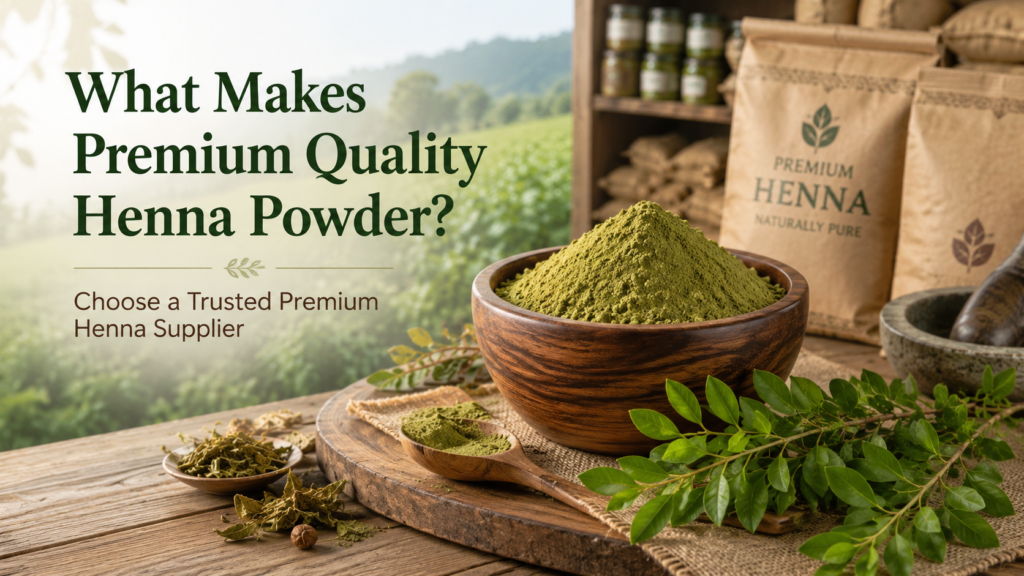
Henna buyers often begin with color. Will it stain well? Will it mix smoothly? Will it feel comfortable on hair or skin? Those questions matter, but they do not explain the full quality story. Powder performance is shaped much earlier, through leaf selection, cleaning, drying, milling, sieving, storage, and packing.
A premium henna supplier understands that customers are not simply buying a green powder. They are choosing a product that should behave predictably in real use. It should create a workable paste, feel clean in application, remain consistent across batches, and arrive in packaging that protects freshness rather than quietly weakening it.
Premium quality begins before the leaves are milled
Good henna starts with the plant itself. Leaves harvested and sorted with care usually create a better finished powder than dusty, mixed, or poorly handled material. Strong processing cannot fully rescue weak raw inputs, which is why sourcing deserves attention from the start. Buyers often prefer working with an experienced original mehndi manufacturer in India that follows consistent quality and processing standards.
Leaf maturity, harvest timing, and cleanliness
Clean leaf material supports a cleaner end product. Twigs, grit, stale fragments, and excess rough matter can influence how the powder feels once mixed. For professionals, that difference becomes visible quickly in paste texture, cone flow, and overall ease of use.
That is where a premium henna supplier creates value early. Consistent inputs make later steps more reliable: milling becomes more even, filtering becomes more meaningful, and finished powder feels less variable from one batch to the next.
Why freshness changes the user experience
Freshness affects aroma, mixing behavior, and buyer confidence. Powder stored poorly may feel flat, clumpy, or less pleasant during preparation. Careful stock handling and protective storage help preserve the natural character of the leaves before they become finished powder.
What a premium henna supplier checks during processing
Processing can protect henna quality or quietly dilute it. Drying, grinding, and filtering must work together to create a clean, practical, dependable powder.
Drying and milling should protect the plant material
Leaves need to dry in a controlled way so they are suitable for grinding and storage. Poor drying can create inconsistency, while careless milling may leave powder that feels uneven. Once processed correctly, the material should be fine enough to support comfortable preparation.
Buyers often associate premium henna powder with final color alone, yet texture matters just as much. A paste that spreads evenly is easier to apply, easier to control, and more pleasant for artists, salons, and home users.
Texture matters more than many buyers realize
A refined powder should feel soft rather than gritty. It should combine with liquid without forming stubborn lumps and support a paste that moves smoothly through a natural henna cone, applicators, or fingers. This is why fine sift henna appeals to serious users.
A premium henna supplier treats texture as a performance feature. Better texture can improve line control, reduce tool blockage, support more even application, and make the entire experience feel more polished.
Purity is not a vague claim
Words such as “natural” and “pure” are easy to print, but buyers need practical signs they can trust. Purity should mean clean processing, honest representation, and no reliance on unnecessary fillers or distracting claims. A straightforward product story often builds more confidence than exaggerated language.
For people seeking high quality mehndi powder, the useful question is simple: does the product behave like clean henna should? It should smell earthy, look naturally green to olive-green rather than artificially bright, and mix into a paste that feels coherent instead of sandy.
Appearance, aroma, and paste behavior
Visual clues cannot prove everything, but they help. An oddly neon tone, an unnatural scent, or a paste that separates poorly deserves caution. In contrast, the best henna quality usually shows up through balance: natural-looking powder, plant-like aroma, and smooth, predictable handling.
Performance is measured in real use
A pouch may look attractive and still disappoint during application. Real quality shows up in preparation, spreadability, comfort, and repeatability. If a powder mixes poorly or performs inconsistently, the issue becomes visible no matter how elegant the package appears.
For hair use, a dependable powder should form a smooth mask that coats without excessive drag. For body art, it should support neat lines and steady flow. This is the practical difference people often mean when they ask for the best quality henna powder.
For salons, artists, retailers, and bulk buyers
Different buyers notice different problems. An artist sees blocked cone tips. A salon sees uneven paste texture. A retailer sees weaker repeat demand. A bulk buyer sees whether one shipment resembles the previous one. Consistency links all of these concerns.
Reliable quality saves time, reduces complaints, and makes it easier to build services or product lines around the powder. When the experience stays familiar from batch to batch, buyers gain confidence instead of constantly adjusting their process.
Packaging, shelf life, and batch consistency
Even well-made henna can suffer if packaging is careless. Exposure to air, moisture, strong odors, or weak sealing can reduce the experience customers receive later. Packaging should protect the powder, communicate clearly, and fit the needs of retail, salon, or wholesale buyers.
This is another place where a premium henna supplier proves its discipline. Good packaging supports freshness, transport safety, storage convenience, and easier handling for brands or distributors working at scale.
Batch consistency matters just as much. Customers appreciate products that feel familiar each time they reorder. That consistency comes from repeatable sourcing standards, controlled processing, and thoughtful packing rather than chance.
How buyers can judge quality before ordering
Not every buyer can inspect a manufacturing floor, but they can ask sharper questions. What is the intended use? How finely is the powder processed? Are packaging sizes explained clearly? Does the product information sound specific, or merely promotional?
A premium henna supplier should answer in practical terms. Buyers benefit from clarity around application suitability, pack formats, processing cues, freshness guidance, and order support. Specific answers reduce guesswork and make confident purchasing easier.
Small test orders can also help. A sample reveals scent, texture, mixing behavior, and user comfort faster than a long list of claims. For professionals and brands, that first trial often says more than polished wording ever could.
Conclusion
Premium quality henna powder is not defined by one label, one shade of green, or one bold promise on a pack. It comes from a chain of sensible decisions: careful leaf selection, clean processing, refined texture, honest purity, protective packaging, and dependable results in real use. That is why choosing a premium henna supplier matters for artists, salons, retailers, and thoughtful home users alike. The right powder should make preparation feel easier, application feel smoother, and results feel more consistent. Buyers do not need technical jargon to judge quality; they need clarity, practical details, and a product that behaves well each time it is opened. When those pieces come together, henna feels less like a gamble and more like a trusted staple for everyday care, creative work, and professional supply across seasons, changing routines, and evolving customer needs over time.